I wasn’t thinking about Chinese New Year when we booked our trip to SE Asia, but when we discovered that it was occurring during the first week of our trip, I was both delighted and apprehensive. Would there be big public events to seek out, or avoid? Would it make transportation a hassle? Would there be fireworks…near us?
We were not going to China, but I knew the Lunar New Year is celebrated widely, and there are Chinese people or influences in all three countries we planned to visit. In this post, I share a few things I learned and observed while traveling in Asia during this auspicious season.
The commercialization of dragons

The dragons started in earnest as soon as we landed in Seoul for our three hour layover. We wandered through the international transfer terminal, boggled by the proliferation of duty-free alcohol vendors. There was a fair amount perfume, too, but so much alcohol (not to mention cigarettes). In the 20 minutes it took us to find a place to buy a bottle of water, we could have stocked several bars. And every liquor brand seemed to have a dragon promo.
It didn’t stop with the booze. Like many Asian cities, Singapore is full of shopping malls, some of them sprawling underground under many city blocks. To access the transit center near our hotel, we had to wind our way through a shopping center full of all the stores you’d see in Europe: Desigual, H&M, Marks & Spencer, Sephora, Hermes, etc. They all had window displays full of dragons.
I suppose the commercialization of a holiday comes as no surprise, but the level of commercialization of dragons in Singapore bordered on ridiculous. I wasn’t sure what to expect in Cambodia and Vietnam, where capitalism has less of a grip.
Understanding Singapore
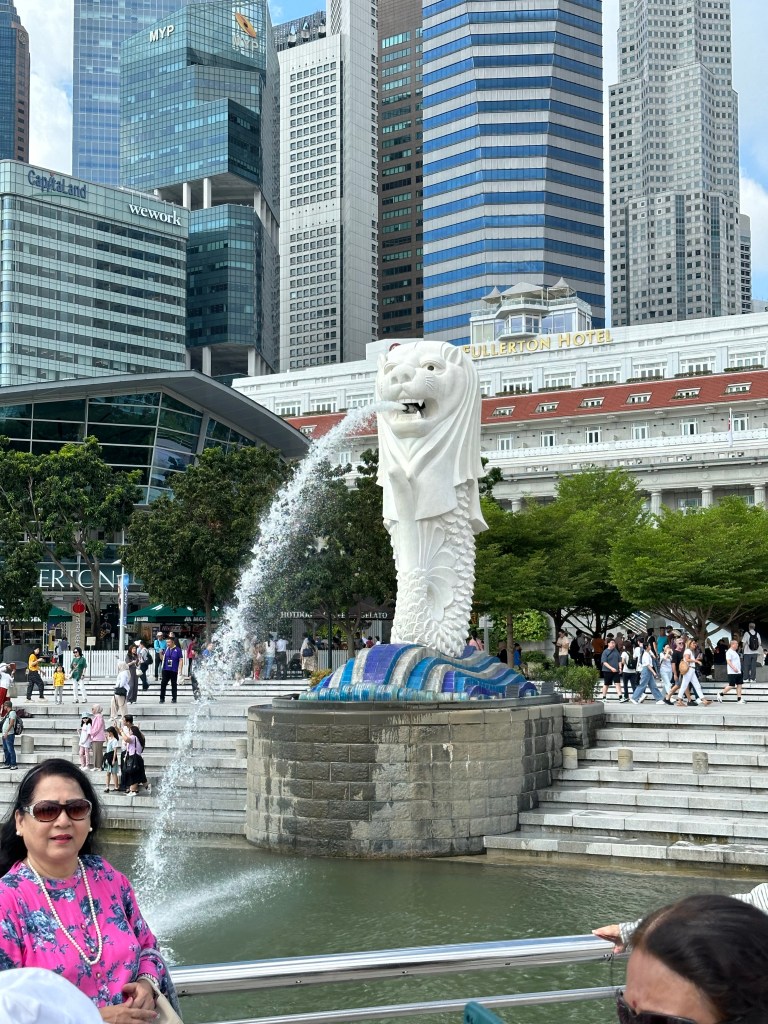
Singapore is a multicultural city-state with four official languages. Colonized by the British Empire in the early 1800s, the influence of colonialism can be seen in the ubiquitous use of English and right-hand-drive cars.
Singapore has had a large Chinese population since the 1400s and celebrates Lunar New Year with gusto. As we left town, carnivals and street barricades were being set up for the weekend’s CNY festivities.
When Singapore gained independence from the British Empire in 1965, there was some tension between those who wanted to rejoin Malaysia, and those who wanted an independent state. The separatists won, and Singapore became an independent island nation-state.
Money seems to be at the heart of Singapore’s identity. Wealth is visible everywhere, and it is not the place to go on your minimalist backpacking tour of Asia. You need money to enjoy Singapore, and dragons hoard wealth. Every luxury mall and most chain stores flaunted dragons. We even saw a giant Lego dragon in Suntec City.
Cambodia… it’s complicated
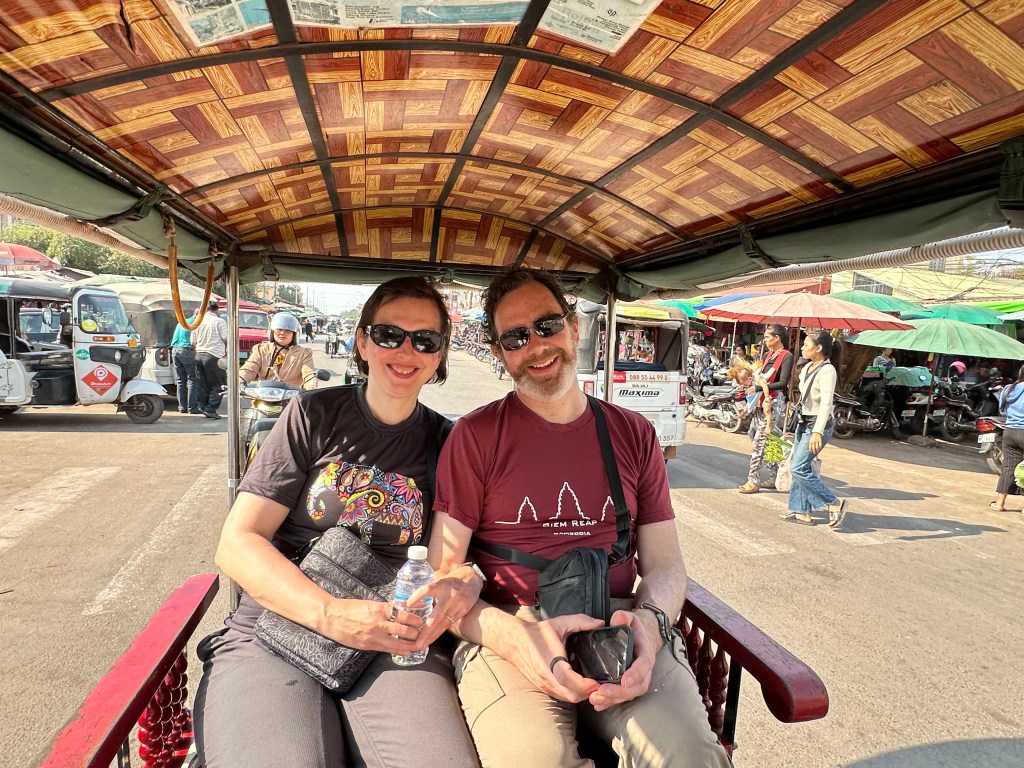
My husband asked our airport driver whether they got more tourists for the holiday, and he seemed confused—what holiday? Once he got the idea that we were talking about the Chinese New Year, he said, “Oh, yeah…happy new year!” with a somewhat sarcastic tone. This was the first small hint that the Khmer people didn’t have much fondness for China. Incidentally, the Khmer New Year is in April.
Still, the Lunar New Year is a thing in Siem Reap. On a morning walk, we saw trucks full of dragon dancers getting ready to perform. There were Lunar New Year banners on a few buildings, but not nearly as many dragons.
Cambodia is a complex place. Now a majority Buddhist country, it has a long history of religious conflict and civil war…not to mention genocide. Wandering through Angkor Wat, hundreds of Buddhas were missing heads or missing altogether.
Our tour guide for our day at the temples gave us a lot of ancient history and a bit of Hindu and Buddhist mythology, but he did not get too into recent history. He made some offhand comments about China and Vietnam that made it clear that the Khmer people feel a bit put upon by the more wealthy neighboring countries that encroach and influence.
The final temple on our full-day tour was “the Tomb Raider one.” When asked if he’d visited the temple when he was younger—before the restoration work began—he said it was too dangerous to go that far out of town back then because of the land mines.
Siem Reap has fully embraced the tourist economy, and the streets were crowded with Tuk Tuks, some of them with themes like Batman or country music. The blatant pandering to Westerners felt awkward yet comforting. We were welcome here.
We booked a “behind the scenes” tour of Siem Reap with a local in a Tuk Tuk, and he gave us a bit more context for Cambodia’s resentment toward China and Vietnam. For centuries, border encroachment has shrunk the land that the Khmer people occupy. Now, these more wealthy neighbors exerted economic pressures that Cambodia could do little to deflect.
Pol Pot’s communist campaign and killing fields had irrevocably scarred and traumatized the people of Cambodia. They wanted nothing to do with their communist neighbors, but Chinese tourism was a big part of the local economy. There were mixed feelings, to say the least.
The Socialist Republic of Vietnam

When Vietnam reunited under the benevolent gaze of “Uncle Ho” in 1975, there must have been a sense in the West that it was a victory for communism. Today, despite the prevalence of hammer and sickle iconography, capitalism is as present in Hanoi as anywhere else we visited.
Hanoi is full of Western fast-food restaurants, luxury shopping malls, and handcrafted souvenirs. I did not feel like I was in a Socialist Republic at any point. Capitalism is alive and well under the benevolent gaze of “Uncle Ho.”
The Lunar New Year is celebrated in Vietnam with a five-day festival known as Tet. You may recall the horror of the “Tet Offensive”? We landed in Hanoi right in the middle of the festival. We could see private fireworks displays from our hotel roof bar in the evenings. During the day, locals dressed up in colorful finery to be photographed in front of temples, landmarks, and dragon signage. The lake shore was crowded with women in vibrant dresses, looking for good spots for photos.
In Cambodia, we had only seen a few hints of the year of the Dragon, but in Vietnam, we were once again inundated with dragons in every shop window, as well as on large banners and signs lining the streets.
On our first day in Hanoi, we visited the Vietnamese Women’s Museum, which gave me a better overview of Vietnamese culture and history than I had ever received in school. From indigenous cultures to guerrilla warfare, women have played critical roles in Vietnam’s development and continue to flourish in business, science, and the arts. Maybe the tradition of Mother Goddess worship has helped women gain a prominent status in Vietnam.
On our day tour of Ha Long Bay, we became part of the throng of tourism. The bay was full of tourist boats, small cruise ships, and fishing boats. It was busy but still stunningly beautiful. Our cheerful tour guide pointed out rocks that were shaped like things… a tiger, a dragon, a butterfly. I would have preferred more history or geology, but…rocks are cool.
Chilly Seoul

By the time we got back to Seoul, CNY celebrations were dying down, and after two weeks of tropical heat, the return to winter was jarring.
South Korea is proudly capitalistic, and Seoul feels like any large Western city, but it has random ancient temples nestled among the glass and steel skyscrapers. In the juxtaposition of new and old, it reminds me a bit of Tokyo.
With only one day to spend in Seoul, we found a contemporary art museum across the street from an ancient castle and made that our destination. I always try to find contemporary art in the cities I visit. History is interesting, but contemporary art often looks to the future and helps me understand the present.
The museum had several immersive exhibits, and one focused on a dancer who had been a key player in the LGBTQ rights movement in South Korea. I always find it touching to understand how social justice movements play out around the world, often following a similar trajectory on a different timeline.
Two weeks was not enough. We had seven flights and spent more time in line for airport security or passport control than I would have liked. But once we got to SE Asia, we wanted to cover as much ground as possible. It was worth it, but next time, I’ll pick one or two destinations.
 Plumb Wonderful